
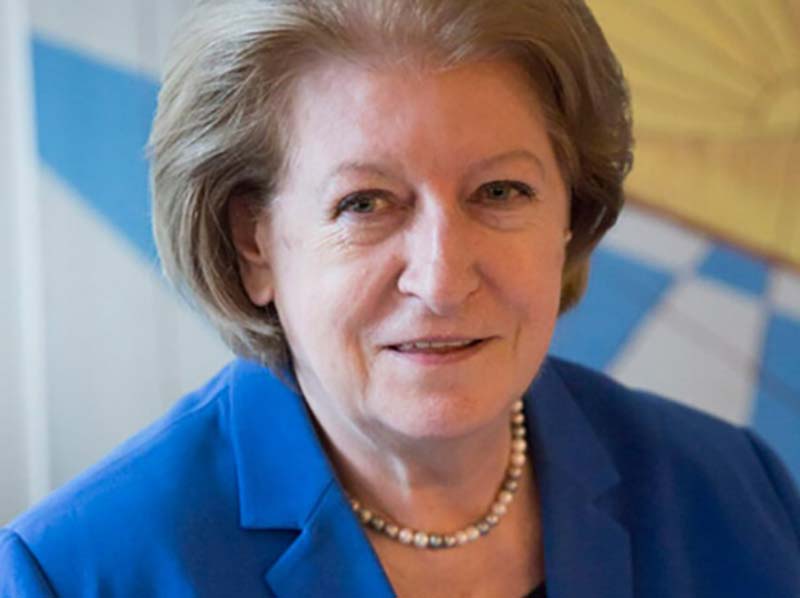
© Photo, Council of Europe
The XXX International Grupo Compostela–Xunta de Galicia Prize is awarded this year to Hanna Suchocka, a figure who, according to the jury, will go down in history for perfectly combining the academic and socio‑political spheres in her firm defense of human values. A political pioneer, she became the first woman to hold the office of Prime Minister in Poland (1992), at a decisive and unprecedented moment in the country’s transition toward a democratic system that required the consolidation of institutions, laws, and political practices characteristic of a Rule of Law.
The jury’s decision, reached unanimously during an online meeting held on 21 May 2026 from the Galician capital, recognizes a lifetime dedicated to research, university teaching, political action, and pacifist activism—fields in which Suchocka has left a deep and lasting mark. The laureate embodies both the symbolic and real value of a figure who opened paths for women in leadership roles, and “her career has been very much in line with the values of the Camino de Santiago, being a forerunner in the defense of democracy,” highlighted the president of the Compostela Group of Universities (GCU), Carla Martins, during the meeting.
For their part, the rectors of the University of Santiago de Compostela, Rosa Crujeiras, and the National University of San Marcos, Jeri Ramón, emphasized the human and social dimension of the prize-winner, recalling that “her commitment to democracy made her a trailblazer who transcended the academic sphere to influence society” and that “she is especially important for all women, due to the relevance of her work, her academic background, and her activism in a world that continues to be deeply sexist.” These views were supported by the rector of the Thecnical University of Cartagena, Mathieu Kessler, who stressed that Suchocka “combines academic excellence with activism in the service of society through her political role,” a synthesis that explains her international influence and the lasting impact of her work in politics and society.
The jury members representing the Xunta de Galicia, José Alberto Díez de Castro, secretary-general for Universities, and Anxo Lorenzo, director-general for Culture, agreed that, in addition to being a leading academic figure, Suchocka possesses a historical dimension and a leadership style closely tied to ethical commitment—factors that were decisive in the unanimous granting of the prize. These remarks also reflected the views of the regional minister for Education, Science, Universities and Vocational Training, Román Rodríguez, president of the jury.
The award ceremony will take place on 14 September 2026 at Adam Mickiewicz University in Poznań, the institution where Hanna Suchocka began her academic career. Born in Pleszew (Poland), she studied legal sciences with a specialization in constitutional law and human rights, and developed an extensive academic career between 1968 and 2013 at the aforementioned university in Poznań, at the Polish Academy of Sciences, and at other institutions in the country.
Her commitment to defending the Rule of Law led her to become actively involved in the political life of her country. She served as a member of the Polish Parliament in two periods and participated in key committees, including the Constitutional Committee of the National Assembly responsible for drafting the Constitution of the Republic of Poland. After becoming the first woman to lead the Polish transitional government in 1992, she served as Minister of Justice and Attorney General, and represented Poland before the Holy See as ambassador between 2001 and 2013. At the European level, she stood out for her participation in the Venice Commission, where she served as vice-president and has been honorary president since 2016.
Her career has been recognized with five Honoris Causa from various universities in Poland, Italy, and the United States of America, as well as numerous other international distinctions, including the Gold Medal of the Jean Monnet Foundation for Europe, the Max Schmidheiny Prize, the Order of the White Eagle, the International Saint Adalbert Prize, the French Legion of Honor, and the Klaus Hemmerle Prize.
More information is available on the website of the XXX International Grupo Compostela–Xunta de Galicia Prize.