Erasmus + Project 2025-1-ES01-KA131-HED-000344778
Project co-funded by the Erasmus+ programme of the European Union. Call KA131-HED – Mobility of higher education students and staff supported with internal policy funds (2025). The content of this website is the sole responsibility of the GCU. Neither the European Commission nor the Spanish Service for the Internationalisation of Education (SEPIE) are responsible for the information disseminated herein or for any use that may be made of it beyond this website.


COORDINATOR

MEMBERS OF THE CONSORTIUM
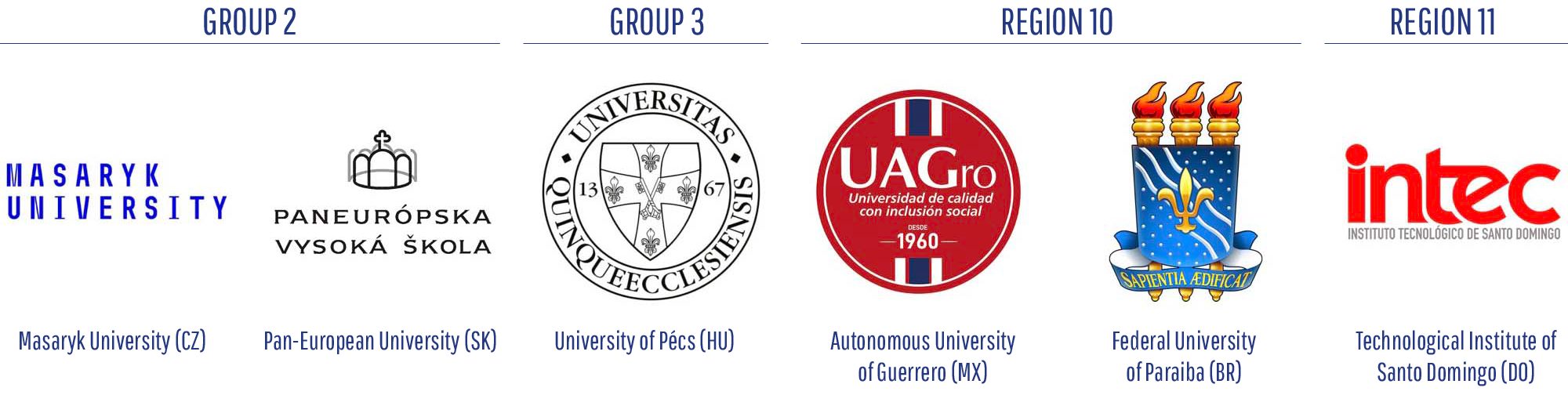
Group 2

MEMBER UNIVERSITIES
OBJETIVOS
The Erasmus+ KA131-HED CGU EU–America 2025–2027 project aims to strengthen academic cooperation between Europe and Latin America through short-term mobility for students undertaking traineeships and for higher education staff for teaching and training purposes. Its objective is to promote internationalisation, training in strategic areas, and sustainability within the framework of the Erasmus+ programme.
CONTENT OF THE PROJECT
Motivation
To promote sustainable initiative, strategy, communication, and sustainable future-building among European and American universities, in line with the development policies and objectives of the CGU EU–America Mobility Consortium (2024-1-ES01-KA130-HED-000212899).
Action
Expansion of opportunities for regional integration and the creation of synergies for growth among member countries in Groups 2 and 3 in Europe and third non-associated countries in Regions 10 and 11 in America, through:
-
- Student mobility for traineeships.
- Staff mobility for teaching.
- Staff mobility for training.
Special Efforts
- Increase in mobility for recent graduates at undergraduate and postgraduate level, and of academic and non-academic staff, to attract and exchange young talent and knowledge.
- Expansion of institutional resources for individual and corporate mobility to foster the creation of new scenarios for cooperation and development.
- Transfer of social responsibility policies to practical implementation through specific mobility actions and interventions.
- Support for digital transition and internationalisation at home through the incorporation of virtual components into individual mobility.
- Contribution to the promotion of dynamic regulatory measures within academic frameworks and recognition systems.
PROJECT DURATION
26 months
ELIGIBLE PERIOD
from 01/06/2025
to 31/07/2027
BUDGET
Student mobility for traineeships: 12,664.00 €
Staff mobility for teaching: 9,234.00 €
Staff mobility for training: 10,361.00 €
Total mobility budget: 32,259.00 €
Organisational support: up to 400 € per mobility.
Total budget: 41,059.00 €
* Shared budget for international mobility: maximum 20%.
* Shared budget for mobility with Mexico and Brazil: maximum 30%.
* The project promotes green travel.
GEOGRAPHICAL AREA
Europe – Groups 2 & 3
North Atlantic Axis in Spain
(Galicia, Asturias and Castile and León)
Central Europe
(Slovakia, Hungary, Czech Republic)
America – Regions 10 and 11
Southern North America (Mexico)
Caribbean (Dominican Republic)
South America (Brazil)
PLANNED MOBILITY
–PARTICIPANTS–
Student mobility for traineeships: 6
Staff mobility for teaching: 8
Staff mobility for training: 8
TOTAL: 22
PLANNED MOBILITY
–FEWER OPPORTUNITIES–
50% in each mobility category.
MODALITY
Short-term mobility with a virtual component
PRIORITY ACADEMIC FIELDS
- Defence, security and cybersecurity; international law, migration and management
- Fundamental rights and democratic participation
- Welfare economics, social market, media and public opinion, identity
- Biotechnologies, medical technologies
- Green and digital transition
INCLUSION INDICATORS
Inclusive mobility will be promoted, with special attention to the following groups:
- Women in underrepresented academic fields — New Technologies and Emerging Technologies
- Students who are vulnerable or at risk of social exclusion
- Students from areas declared to be in environmental emergency
- Students from regions affected by armed conflict or sociopolitical repression
- Students with special needs, with at least 33% officially recognised disability
* Students with special needs may request to be accompanied by a family member during their mobility.
* Member institutions in the project are expected to appoint a technical coordinator and a coordinator specialising in social responsibility, as well as a mentor.